
 |
 |
 |
| |
|||
|
|
||
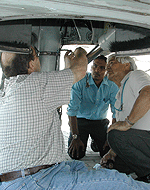
The FAA’s international reach extends from some of the biggest countries in the world to some of the world’s smallest islands.A recent flight check mission took FAA employees from the central United States literally around the world to help the small island nation of the Maldives that had been swamped by the December tsunami. On March 27, FAA pilots Chris Lenckus and Ken Jack — along with maintenance specialist Rick Denson and mission specialist Bill Hoffman — took off from Oklahoma City to start a 27,000-mile, 5-day commute that included stops in Germany to perform a flight check and fuel/duty stops in Egypt and Oman. Their mission was to restore navigational aids that are vital to the Maldives, whose economy is based on tourism. First the crew had to overcome problems with the landing gear. “We discovered a landing gear indication problem that could have jeopardized the entire mission,” recalled Hoffman of the landing in the Maldives. “In terms of maintenance support, a tiny island was not a great place to be broken down.” But two FAA maintenance employees, Al Montes and Paul Solheim, had been in the Maldives for six weeks putting up a temporary VOR. Although they don’t normally work on aircraft, they had just the tools and supplies Denson needed. They worked through the night to solve the problem, so that by next morning the plane could perform its mission. Next, a printer malfunctioned, again threatening the mission. Inspectors need printouts to analyze data collected on the mission. After trying several back-up plans, the crew decided it was time to call home base with the bad news. More than a few Oklahoma City employees lost some sleep that night as they scrambled to find a solution. “Everyone went to work on the problem and we were back in business within 30 hours with a brand new printer,” said Hoffman. “The [Maldives] airport manger was ecstatic. The ILS restoration went smoothly and the Maldives finally had a new instrument approach to the north.” The remainder of the navigational aids also were restored. With the help of the Flight Inspection Central Operation, navigational aids maintenance department, and Flight Inspection Operations, and Aircraft Maintenance and Engineering Division, the 27,000-mile “service call” turned out to be a big success. |
|
|
“In
terms of maintenance support, a tiny island was not a great place to be
broken down.” |
||
| We appreciate your feedback: jim.tise@faa.gov
|